
How to Search McHenry County Court Records
McHenry County court records search starts with the Circuit Clerk's public case access page, not a third-party site. The Clerk maintains the official case index for the Twenty-Second Judicial Circuit, and the public portal lets users open cases by name, party, or case number without paying a fee. The portal covers civil, criminal, family, probate, traffic, small claims, foreclosure, eviction, chancery, and ordinance matters routed to court, subject to confidentiality rules for certain case types. The main entry point is the public case access landing page, which links out to the live search interface.
Before starting, gather what you know about the case: full legal name with spelling variants, business or estate name, approximate filing year, case type if known, and any case number from prior paperwork. A case number is faster and more accurate than a name search, especially for a common name. The official McHenry County court records lookup runs through the McHenry County Public Case Access portal; certified copies are ordered through the Circuit Clerk copy-request page.
- Open the Circuit Clerk public case access portal in a normal browser session. If a security check appears, allow cookies and scripts; command-line tools are blocked.
- Search by case number when you have it. Illinois case numbers identify year, case type, and sequence.
- If the case number is unknown, search by party name. Try maiden names, business suffixes, hyphenated surnames, and initials.
- Narrow by case type or date range if the portal exposes those filters, especially for high-volume traffic or misdemeanor matters.
- Open the case detail page to read docket events, parties, judge assignment, court dates, and disposition fields where public.
- If a document image is not available online, request a plain or certified copy from the Circuit Clerk through the official copy-request form.
- If no result appears, consider sealed, expunged, juvenile, or recently filed matters that may not be indexed in the public portal yet.
A blank result does not always prove a case never existed. Sealed, expunged, juvenile, impounded, or recently dismissed matters can be hidden from the public index even when the underlying event happened. For urgent deadlines, call the Clerk's office at 815-334-4190 before relying on what the portal shows.
McHenry County Court Records Search Fields
The public case access portal exposes a set of search fields that lets users narrow by case number, by name, by birth date, by case type, or by date range. Each field can be used alone or combined. The table below lists the fields a public user can expect at the portal. Exact field placement may shift if the county updates the site, but the search logic stays the same.
| Field | Type | Required | Notes |
|---|---|---|---|
| Case Number | text | optional | Most precise lookup; use the full Illinois case number with year and case-type code. |
| Last Name / Business Name | text | required for name search | Enter party surname or business or entity name; try spelling variants. |
| First Name | text | optional | Narrows results for common surnames. |
| Middle Name / Initial | text | optional | Use if known to reduce false matches. |
| Date of Birth | date | optional | May be available for criminal and traffic searches where public and permitted; verify in a browser session. |
| Case Type | dropdown | optional | Categories include civil, criminal, traffic, family, probate, small claims, law, chancery, and ordinance. |
| Date Range | date fields | optional | Filter by filing date, offense date, or court date depending on the portal tab in use. |
| Search button | button | n/a | Runs the query against the public index. |
A few practical tips help avoid bad results. Search broadly first, then narrow with case type or date range. Use full legal names for individuals and check business filings under every legal variant, including "LLC," "L.L.C.," former names, and abbreviations. For probate, search the decedent's name rather than the personal representative's. For guardianship, search the ward's name. Online case access is not legal notice; parties remain responsible for notices served through the case, attorney communications, and court orders entered on the docket.
What a McHenry County Court Record Shows
A court record is more than a one-line outcome. Each case file holds a chronological docket plus the documents the parties and the court generated along the way. The McHenry public case access portal exposes most of the index data; document images may need a separate copy request through the Circuit Clerk. The field inventory below covers what a typical case detail page returns.
| Field | What It Shows |
|---|---|
| Case Number | Year, case-type code, and sequence assigned by the Clerk at filing. |
| Filing Date | The date the initiating pleading or charge was filed. |
| Caption / Parties | Plaintiff and defendant, petitioner and respondent, People v. defendant, or estate caption. |
| Case Type | Civil, criminal, traffic, family, probate, small claims, chancery, law, or ordinance. |
| Status | Pending, active, disposed, dismissed, judgment, supervision, sealed, transferred, or stayed. |
| Judge / Courtroom | Assigned judge, courtroom, hearing time, division. |
| Docket Entries | Filings, motions, orders, returns, continuances, plea, sentence, payment, and warrant events. |
| Financial | Fines, fees, costs, bond, restitution, payment plan, and balance due where public. |
| Documents | Image links where available; certified or plain copies otherwise come from the Clerk. |
Document availability differs from docket availability. Many cases show full docket text without free document images. If a record will be used in another court, with a licensing board, or for an immigration filing, request a certified copy through the Circuit Clerk rather than relying on a portal screenshot. The Clerk's copy-request page walks the user through the steps.
The image below comes from the official Circuit Clerk copy-request page for McHenry County court records.
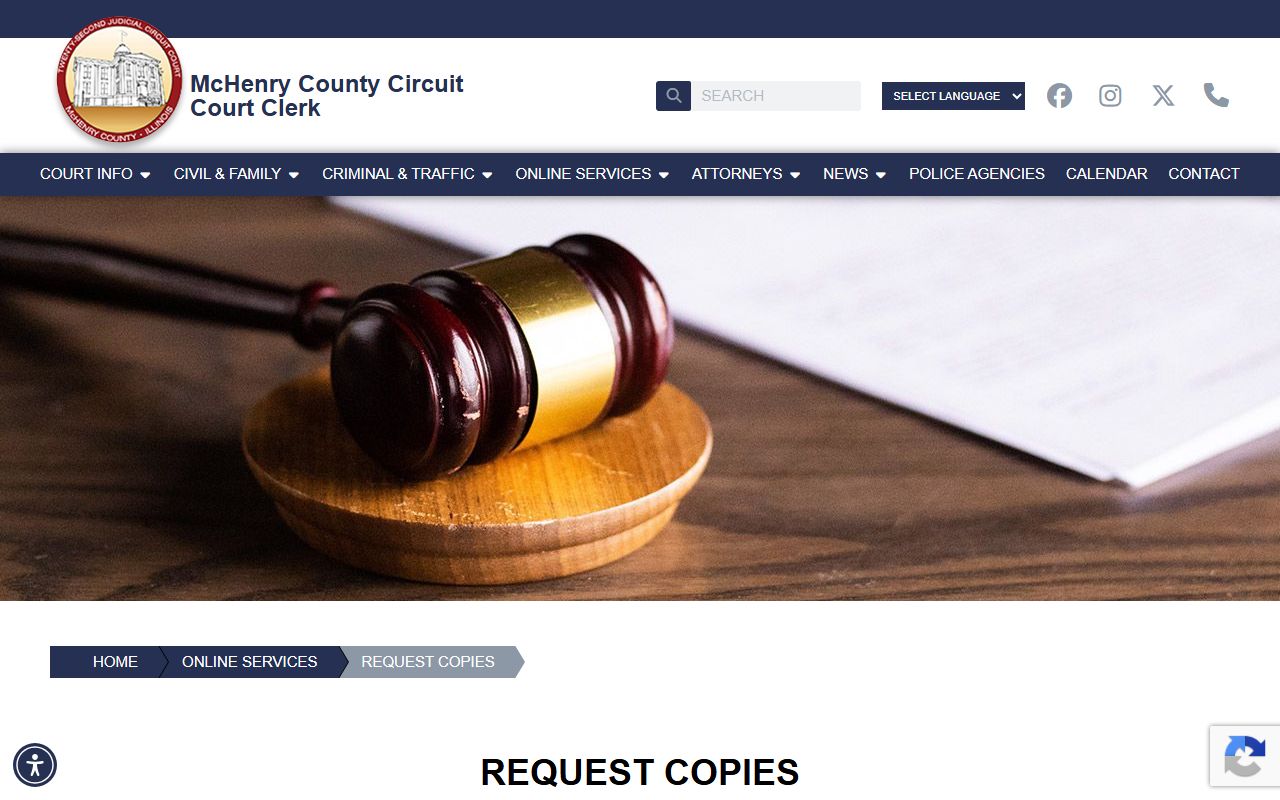
The page lets a user identify the case number, requester name, address, and certification choice before a copy is mailed or held for pickup at the courthouse.
Types of McHenry County Court Records
Cases filed in the McHenry County Circuit Court fall into a handful of broad categories. Each category follows its own filing rules, courtroom calendar, and confidentiality protections under Illinois statute and the Illinois Supreme Court rules. The categories below cover the bulk of what shows up on the public docket.
- Civil records: complaints, summonses, appearances, motions, orders, judgments, satisfactions, garnishments, plus small claims, chancery, mortgage foreclosure, eviction, and administrative review. See the civil division page.
- Criminal records: charging instruments, bond orders, plea documents, sentencing orders, probation orders, and dispositions for felonies and misdemeanors. See McHenry County arrest records.
- Family records: divorce, parentage, allocation of parental responsibilities, parenting time, support, maintenance, and post-decree enforcement, listed on the family division page.
- Probate records: decedent estates, wills admitted to probate, letters of office, claims, inventories, accountings, and guardianships of disabled adults and minors. See McHenry County probate records.
- Traffic and ordinance records: citation number, charge or statute, plea, supervision, conviction, fines and costs. See McHenry County traffic court records.
- Juvenile and mental-health records: restricted by statute; public portals usually omit or limit display.
Civil cases in McHenry County include landlord-tenant evictions, mortgage foreclosure cases filed by lenders, small claims for amounts below the statutory ceiling, chancery cases for equitable relief, and administrative review actions. Criminal cases run from misdemeanor citations through felony prosecutions. The Circuit Court is also where domestic violence orders of protection, civil no-contact orders, and stalking no-contact orders are heard, though parts of those files may be sealed for victim safety.
Which Office Holds Which McHenry County Record
One of the most common search pain points is asking the wrong office. McHenry County has a split records structure: court files sit with the Circuit Clerk, vital records and marriage licenses sit with the County Clerk, and recorded land documents sit with the Recorder. A divorce decree is a court file because dissolution is a court case, but the marriage license that began the marriage is a county vital record. A judgment entered in court is a Circuit Clerk record; if the judgment is recorded as a lien on real estate, the Recorder also holds a copy of that recorded instrument.
| Record Request | Best Office | Why |
|---|---|---|
| Criminal disposition | Circuit Clerk | Court file shows the final disposition and supports certification. |
| Arrest report or narrative | Arresting agency or Sheriff (FOIA) | Police-created record, not a court docket entry. |
| Booking or custody status | Sheriff's corrections / inmate lookup | Jail controls live custody data. |
| Divorce decree | Circuit Clerk | Dissolution is a court judgment in a court case file. |
| Marriage certificate | County Clerk | Marriage is a vital and county-level record. |
| Deed or mortgage | Recorder | Recorded land instrument, separate from any related court case. |
| Probate letters of office | Circuit Clerk | Issued by the court in the probate case file. |
| Traffic payment balance | Circuit Clerk | Court costs and fines are assessed in the traffic case. |
| Driver license status | Illinois Secretary of State | Driver record is separate from the court traffic file. |
| Federal indictment or docket | PACER or federal court | Federal courts run a separate sovereign system. |
If a search returns nothing, ask whether the record is a court file or an agency file before changing the search method. A FOIA request to the Sheriff or County Clerk does not retrieve a court file, and a Circuit Clerk copy request does not retrieve a police body camera video.
Public Access Laws for McHenry County Court Records
Illinois treats court records and agency records under two different access frameworks. Court files held by the Circuit Clerk are accessed through clerk procedures, court rules, and the public portal, not through FOIA. Records held by the Sheriff's Office, County Clerk, Recorder, and the State's Attorney administrative side are public-body records subject to FOIA, with exemptions for personal privacy, law-enforcement interference, juvenile information, victim data, and records prohibited from disclosure by other law.
Key Illinois Statutes:
5 ILCS 140: Illinois Freedom of Information Act. Public records are open unless an exemption applies; requests go to the public body's FOIA officer, and denials may be reviewed by the Attorney General Public Access Counselor.
20 ILCS 2630: Criminal Identification Act. Governs state criminal-history records, arrest reporting, and the mechanics of expungement and sealing.
705 ILCS 405: Juvenile Court Act of 1987. Restricts juvenile records and defines who may access them.
The Circuit Clerk is not an investigative agency. The Clerk keeps the official court file and the docket; police reports, body camera footage, 911 audio, and incident narratives belong with the law-enforcement agency that created them. Illinois State Police criminal-history records are also separate from the McHenry public case docket: a court docket can show a disposition for one case, while a state criminal-history response can show arrests and convictions reported through statewide criminal-identification systems.
FOIA exemptions matter when a user asks the Sheriff or the County Clerk for records connected to a court case. Personal privacy, law-enforcement interference, confidential sources, juvenile records, trade secrets, attorney work product, security vulnerabilities, and records prohibited from disclosure by other law can keep an entire file or parts of it out of public release. Illinois Supreme Court rules also redact Social Security numbers, full account numbers, and protected identifiers from public filings under court rules and privacy statutes.
Restricted McHenry County Court Records
Not every case in the Circuit Court is open. Juvenile delinquency and abuse or neglect cases are restricted under 705 ILCS 405. Authorized users can include the minor, parents or guardians, attorneys, prosecutors, probation, agencies, and court-approved persons. The public case access portal may suppress or redact juvenile cases entirely, so a blank result for a minor's name does not prove no case ever opened.
Sealed and expunged records under 20 ILCS 2630 are removed from ordinary public access. Expungement removes eligible arrest and court records from public view; sealing hides eligible records from the general public but may leave access for law enforcement, courts, and certain employers or licensing bodies. Adoption records are confidential under 750 ILCS 50, and access usually requires statutory authorization or a court order. Mental-health treatment and commitment information is restricted under 740 ILCS 110.
The expungement and sealing process in Illinois usually begins with a petition filed in the Circuit Court where the arrest or charge happened. Eligibility depends on the charge, the disposition, the waiting period, the petitioner's prior record, the supervision or probation type, and statutory exclusions. Notice goes to prosecutors, police, Illinois State Police, and other required agencies. Common denial reasons include an ineligible conviction, an incomplete waiting period, pending charges, missing disposition, the wrong county, or a failure to list each affected agency.
Note: A finding that a record cannot be found in the public portal does not prove no record exists; juvenile, sealed, and expunged cases are hidden from public view by design.
Court Records Glossary
Docket entries use clerk shorthand and legal terms that confuse casual readers. The glossary below covers the words a McHenry County court records user will see most often when reading a public case detail page or a certified disposition.
- Plaintiff
- The party who starts a civil lawsuit.
- Defendant
- The party sued in civil court or charged in criminal court.
- Motion
- A written or oral request for a court order.
- Order
- A judge's directive resolving an issue or setting requirements.
- Disposition
- The outcome of a case or charge.
- Docket
- The chronological case-event register kept by the Clerk.
Other entries are worth a quick definition in plain language. "Continuance" is a postponement of a hearing or deadline. "Supervision" is an Illinois disposition that may avoid a conviction if the defendant completes the conditions. "Nolle prosequi" means the State's Attorney dismissed the charge. "Bench warrant" is a warrant issued by a judge, often for failure to appear. If a docket entry will affect a license, a release condition, or a deadline, confirm the meaning with an attorney or with Illinois self-help resources before acting.
Copies, Certifications, and Fees
The Circuit Clerk publishes copy, certification, and filing fees through the official Clerk fee page. Exact current amounts should be confirmed before mailing a request, because Illinois courts adjust filing assessments under the Criminal and Traffic Assessment Act and the Clerks of Courts Act. Plain copies cost less than certified copies. Certified copies are needed when a record will be used in another court, with a government agency, or for legal proof such as immigration filings, background checks, or licensing applications.
Court-copy requests should be framed around the official case file. The requester identifies the case number, party names, approximate year, document name, and whether a plain, certified, or exemplified copy is needed. If a user asks the Clerk for "my record," staff may ask for clarification because a single person can have traffic, criminal, family, civil, and probate matters that each sit in a different file. The Circuit Clerk also offers online payments through the official Clerk site for eligible traffic and case balances.
Fee waivers are available to self-represented filers who cannot afford filing costs. The statewide Illinois fee-waiver form is available through the Illinois Supreme Court approved forms library. Local court forms and links to the statewide form library are also posted on the Circuit Clerk forms page.
Self-Help for McHenry County Court Records Users
Self-represented litigants in McHenry County have several official resource lines. The Illinois Courts publishes a statewide self-help center that covers common case types in plain language. The Illinois Supreme Court approved forms library carries standardized forms for divorce, parenting, fee waivers, eviction, small claims, name change, expungement, and sealing.
The image below comes from the Illinois Courts self-help center, which serves McHenry County court users along with the rest of the state.
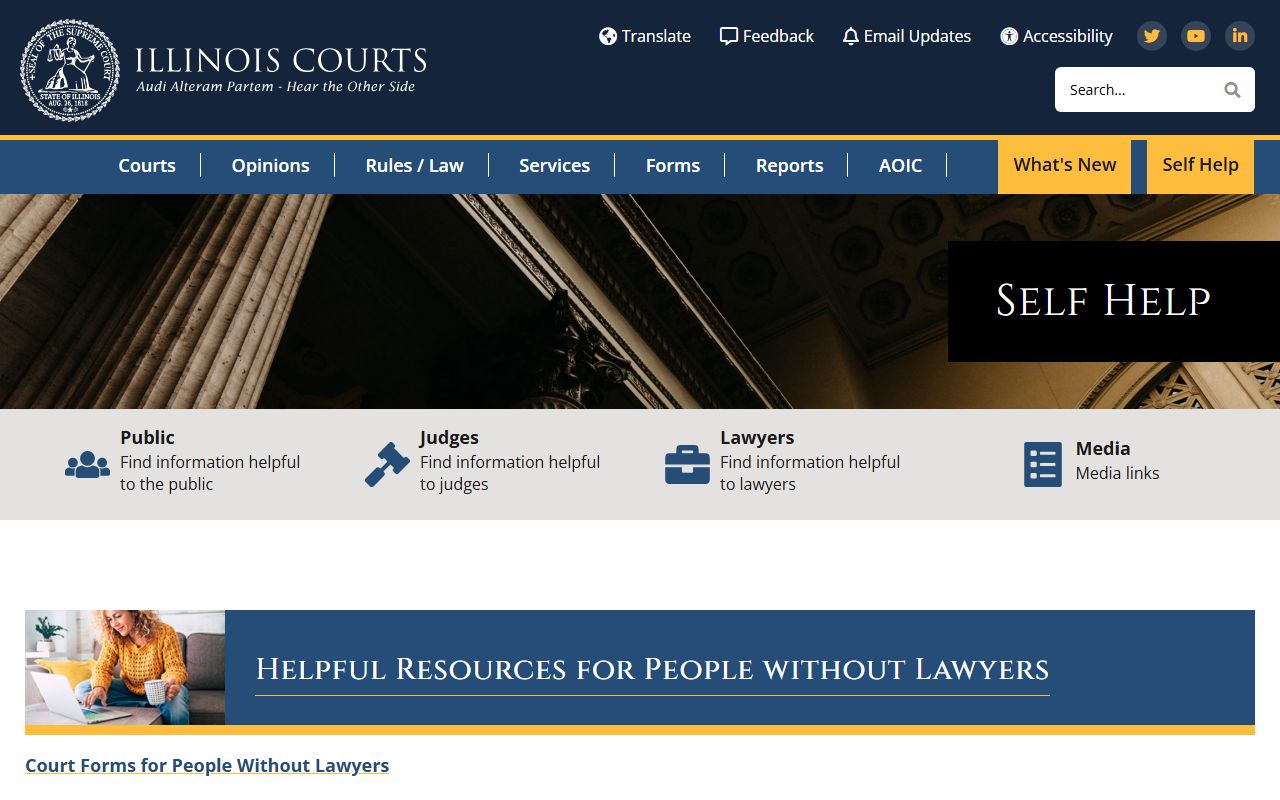
The self-help center routes users to guided interviews, plain-language overviews, and the approved forms library, all of which apply to a McHenry County Circuit Court case.
Court staff and Clerk staff can supply forms and procedural information but cannot give legal advice. People with criminal charges, contested custody, immigration consequences, or complex probate or property disputes should consult an attorney. Prairie State Legal Services covers McHenry County residents who meet income and case-type guidelines, and Illinois Legal Aid Online supplies statewide legal information and step-by-step guides for self-represented users.