
Is There an Official McHenry County Warrant Search?
An official standalone McHenry County active warrant public search was not confirmed during research. The McHenry County Sheriff's Office does not publish a single click-through "all open warrants" list on its public site. Instead, warrant information surfaces in three places: the Sheriff's newsroom and press release page, the Circuit Clerk's docket entries on cases where a judge has issued a warrant, and the county jail roster for people already arrested on a warrant. None of those three is a true warrant list. Each shows a slice of warrant activity tied to a different official event.
That gap is normal in Illinois. Many counties do not run an open public warrant portal because publishing the full active list can tip off subjects, expose sealed search-warrant work, and create safety risks for deputies and victims. McHenry County users should treat warrant search as a multi-source task: confirm any tip through the Sheriff or the Circuit Court before acting on it. Do not rely on a screenshot from a private site as proof that a warrant is current.
The official county portals that touch warrant data include the McHenry County Public Case Access portal, the Sheriff's corrections page, and the Twenty-Second Judicial Circuit at 22ndcircuitil.gov. Each shows a different layer of the warrant lifecycle.
Types of McHenry County Warrants
Not every McHenry County warrant is the same legal instrument. The Illinois Code of Criminal Procedure at 725 ILCS 5 governs how warrants are sought, issued, and served. A user trying to make sense of a warrant entry on a docket or in a news release should know which type they are reading, because the rules for resolution differ.
- Arrest warrant: issued when a judge finds probable cause to believe a person has committed an offense, or after charges are filed and the court orders the defendant brought in.
- Bench warrant: issued by a judge, most often for failure to appear at a scheduled court date or for violating a court order.
- Search warrant: authorizes officers to search a place, vehicle, device, or person; may remain sealed during the investigation.
- Fugitive or out-of-county warrant: issued in another county or state, with a possible hold and extradition through McHenry County.
- Body attachment: a civil writ used to compel a person to appear when a court has ordered it, often in support or contempt matters.
- Contempt or rule-to-show-cause process: can lead to a warrant when a party has failed to comply with a court order.
Search warrants in particular sit apart from the others. They are tools of an active investigation, and the supporting affidavit can be sealed by court order. Even after a search is executed, the file may stay sealed for a period to protect ongoing work. Restricted records, including sealed search-warrant material, are flagged in county research as outside ordinary public access, so users should not expect to read a search-warrant affidavit by walking into the Clerk's office and asking.
How to Search for a McHenry County Warrant
Because no single warrant list exists, a practical McHenry County warrant search uses three or four official sources in sequence. Each source confirms a different fact: whether the Sheriff has publicly named the subject, whether a judge has formally entered a warrant on a case, whether the person is already booked into the county jail, and whether the matter is tied to an Illinois State Police registry obligation.
- Check the Sheriff's newsroom page for press releases that name a subject or ask for tips on a wanted person.
- Open the Public Case Access portal and search by name or case number; look for docket events labeled "warrant issued," "FTA," "bench warrant," or "body attachment."
- Cross-check the county inmate roster by name or by booking date; a recent booking can show that a warrant has already been served.
- For sex-offender obligations, search the Illinois State Police Sex Offender Registry; non-compliance with registration is itself a basis for a warrant under 730 ILCS 152.
- If the matter is federal, check the U.S. Attorney's Office, Northern District of Illinois press releases; federal warrants do not appear on county dockets.
One soft warning: a clean result in any one of these tools does not prove there is no warrant. It only proves that no warrant is showing in that source at that moment. People with a real legal concern should call an attorney rather than rely on a portal snapshot.
Sample McHenry County Warrant Record Fields
If a warrant-related record is published, either in a press release, on a docket sheet, or in an inmate profile, certain fields show up again and again. The table below maps the fields from the warrant research inventory to what each one tells a reader. Treat any field as point-in-time data, not as a final legal answer.
| Field | What It Shows |
|---|---|
| Name | Subject's legal name and any aliases listed by the issuing court or agency. |
| Warrant Number | Internal warrant identifier used by the issuing court or the Sheriff's records unit. |
| Case Number | Linked criminal, traffic, family, or civil case in the Twenty-Second Judicial Circuit. |
| Charge or Reason | Underlying offense, missed court event, or order violation that triggered the warrant. |
| Issuing Court or Judge | The McHenry County judge and division that signed the warrant. |
| Issue Date | Date the judge signed the warrant; older dates can mean longer search history. |
| Bond or No-Bond | Bond amount or detention condition set under current Illinois pretrial release rules. |
| Agency Contact | Sheriff's records unit or arresting agency listed for tips and surrender questions. |
| Safety Warning | Do not attempt to apprehend a subject; contact law enforcement instead. |
Bond and pretrial status now follow current Illinois law, which moved away from a simple cash-bail-only framework. Some warrants will show no monetary bond, while others will direct a defendant into a detention hearing. Reading a "no bond" line does not always mean a person is being held without any chance of release.
Warrant Search Fields If a Roster Becomes Available
If McHenry County publishes a public warrant search in the future, the expected field structure mirrors the inventory captured during research. The table below is a paraphrase of the standard fields a name-based warrant lookup would offer, useful as a checklist when calling the Sheriff or the Circuit Clerk for help locating a record.
| Field | Type | Notes |
|---|---|---|
| Name | Text | Last and first name; try maiden, hyphenated, and aliases. |
| Case Number | Text | If known, links the warrant to a criminal, traffic, or family case. |
| Warrant Type | Filter | Arrest, bench, failure to appear, body attachment; options not confirmed. |
| Issuing Court | Text or filter | Twenty-Second Judicial Circuit or another court when out-of-county. |
If the Circuit Clerk staff can run an internal search, they will usually ask for a full legal name and a date range. They will not always confirm an active warrant over the phone. That is a deliberate safety choice, not a stonewall.
What to Do If You Have an Outstanding McHenry County Warrant
A McHenry County warrant does not get better with time. Bench warrants on missed court dates can stack with new fees, license consequences, and added charges. The safer path is to verify the warrant through official channels and resolve it on a planned schedule rather than during a roadside stop or a traffic check.
- Verify the warrant through the Sheriff's Office, the Circuit Clerk, or the issuing court before taking action; do not rely on a third-party site.
- Contact an attorney if there is any chance of criminal exposure; the public defender route applies only after the court reviews indigency.
- Do not ignore court notices. Missed dates compound the original problem and can create new bench warrants.
- If surrender is needed, ask the Sheriff's Office or your attorney about location, timing, property, medications, and the bond or pretrial process.
- If the warrant comes from a missed court date, file a motion to recall or request a new court date through the Circuit Court.
- After resolution, confirm the warrant recall is entered on the docket and that law-enforcement databases reflect the change.
Safety warning: Do not attempt to apprehend a person subject to a warrant; contact law enforcement.
Clearance is not instant. Even after a judge recalls a warrant, statewide databases can take time to update. Keep a certified copy of the recall order if an attorney or the court advises it, especially before a job background check or a license renewal.
Bench Warrants and Missed Court Dates in McHenry County
Bench warrants are the most common warrant most people will see on a McHenry County docket. They arise when a defendant fails to appear, fails to comply with a court order, fails to pay an ordered amount, or violates a probation or pretrial condition. The docket may show "failure to appear," "warrant issued," "warrant recalled," or similar event text. A simple missed traffic call can produce a bench warrant if the citation required a court appearance.
Resolution is usually faster than it sounds. The defendant or counsel files a motion to recall the warrant or appears in court so the judge can vacate the warrant and reset the case. Some judges will recall a warrant on the same day; others require notice to the State's Attorney. The court dockets page has a deeper look at how to read these entries, and the court records page shows where to pull the full case file. Defendants with an active warrant should not drive on a suspended license to court because that turns one problem into two.
Search Warrants and Sealed Investigation Material
Search warrants in McHenry County are different from arrest and bench warrants. They authorize officers to search a place, a person, a vehicle, a phone, or a digital account on probable cause. The supporting affidavit can be sealed by court order while an investigation is open, which means the public will not see the underlying basis until the court unseals it or the case is charged and discovery rules apply.
Restricted court material in Illinois reaches further than search-warrant files. Grand-jury materials stay confidential unless a court orders disclosure. Juvenile content under 705 ILCS 405 is suppressed on public portals. Victim-protection information, orders of protection affidavits, and supporting safety data can be redacted from filings. A user who hears about a raid in the county should expect news coverage long before the affidavit becomes public, and may never see the affidavit if charges do not follow.
The image below comes from the Illinois General Assembly page for the Sex Offender Registration Act, 730 ILCS 152, which lays out registration duties for offenders living, working, or attending school in McHenry County and elsewhere in Illinois.
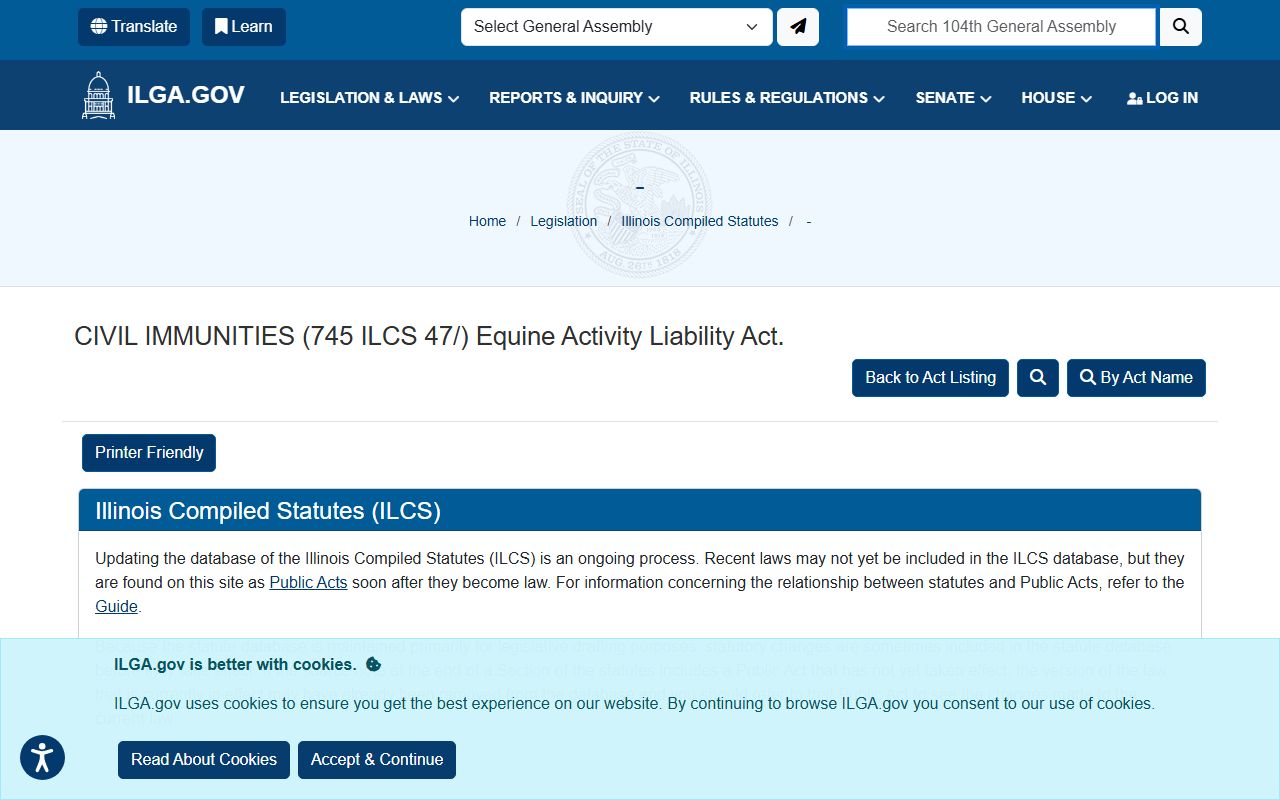
Failure to register under that Act can produce its own warrant cycle, with both the registering agency and the local court drawn into the case.
Out-of-County and Federal Warrants
A person can be picked up in McHenry County on a warrant from somewhere else. Out-of-county warrants come from another Illinois circuit, while out-of-state warrants come from another state's court. Federal warrants come from a U.S. District Court such as the Northern District of Illinois. The McHenry County jail roster may show a hold tied to the outside warrant, but the issuing court controls the case.
Extradition and transport are not automatic. The issuing jurisdiction decides whether it will come pick the subject up, and the receiving court holds the person until the outside agency arrives or releases the hold. Federal cases prosecuted by the U.S. Attorney's Office, Northern District of Illinois never appear on the county docket. Defendants and families should expect to track two systems at once: the county jail roster for custody location and the issuing court for the underlying file.
For inmates already in custody on a hold, the inmate records page covers the visitation, mail, and contact basics. For the related criminal case, the arrest and criminal records page covers charges, dispositions, and how to read a docket. Traffic warrants follow the same logic, with deeper coverage on the traffic court records page.
McHenry County Sex Offender Registry
The Illinois sex-offender system runs through the State Police rather than each county. Registration duties under 730 ILCS 152 apply to qualifying offenders who live, work, or attend school in Illinois, including McHenry County. Non-compliance can produce a new criminal charge and a warrant. The registry itself is public for safety purposes, but it is not a replacement for a full criminal-history check.
The Illinois State Police runs the statewide public registry, which lets users search by name, address, or geographic radius. The image below comes from the Illinois State Police Sex Offender Registry portal, the official lookup for registered offenders in Illinois.
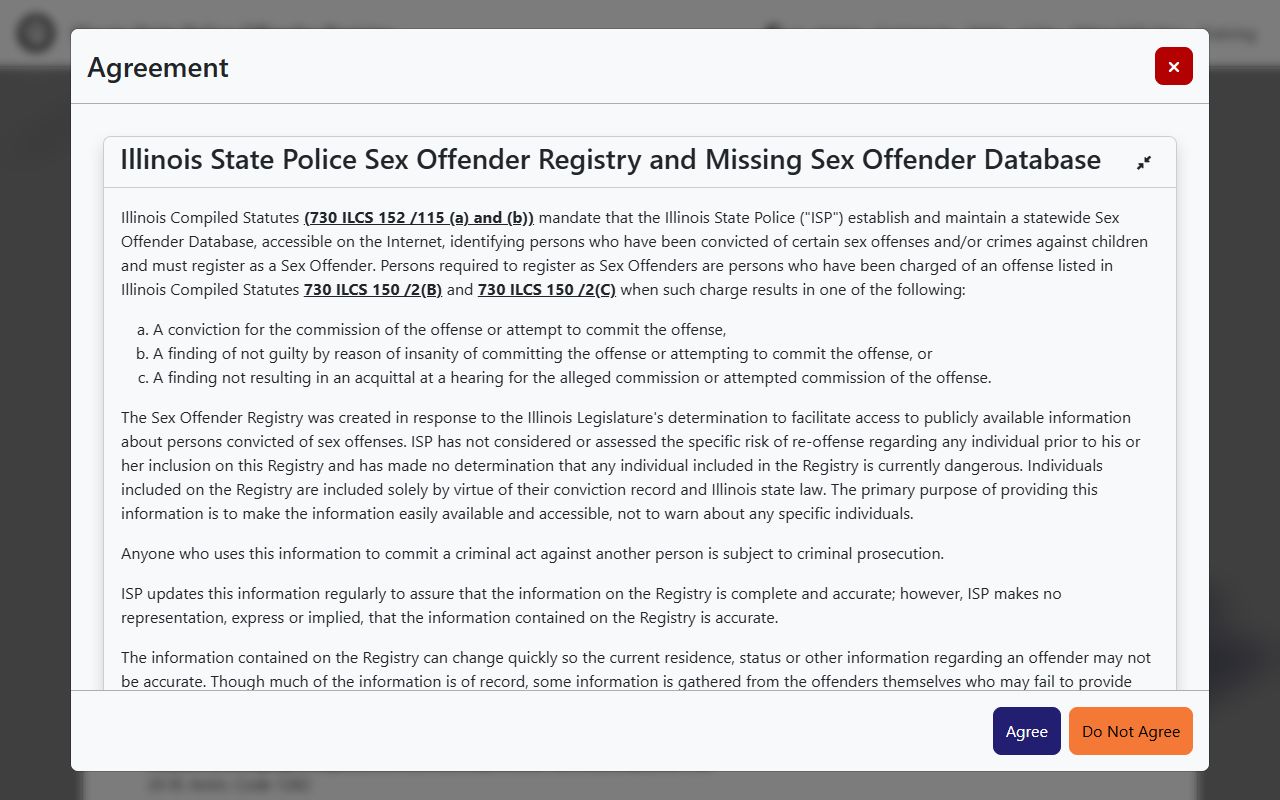
The registry includes a public-safety disclaimer that the data is for the limited purpose set by statute. Use of registry information to harass, threaten, or commit a crime against a listed person can itself be a criminal offense.
Why Third-Party Warrant Sites Should Be Avoided
A McHenry County warrant search done through a paid third-party warrant site is almost always a bad idea. Those sites scrape data from many counties, mix records of different ages, and often blend warrant data with private background-check products. The result is data that looks authoritative but can be stale, wrong, or attached to the wrong person. People have been arrested or detained based on outdated warrant data, and people have paid third-party sites for "warrant clearance" services that the third party cannot actually deliver.
The safe approach is to stay inside official channels. For McHenry County warrant content, that means the Sheriff at mchenrysheriff.org, the Circuit Clerk at mchenrycircuitclerk.org, the public case access portal at caseinfo.mchenrycountyil.gov/pca, and the Twenty-Second Judicial Circuit at 22ndcircuitil.gov. For statewide registry data, the Illinois State Police at isp.illinois.gov/Sor is the official source. For free statewide self-help, the Illinois Courts self-help center is the right starting point.
Note: A clean result on a third-party warrant site is not legal proof of anything; verify any warrant question through the McHenry County Sheriff or the Circuit Clerk before relying on it.