
How to Use the McHenry County Inmate Roster
The McHenry County jail roster is one of two free public tools maintained by the Sheriff's Office. Most users land on one of the two portals from the Sheriff's corrections information page, which is the official starting point for jail searches, visiting rules, mail, money deposits, phone services, and commissary contracts. The roster shows people currently held in the McHenry County jail. It does not cover state prison, federal custody, or out-of-county jails. People held in other systems must be searched in those systems.
Before you search, gather what you know. A full legal name with spelling variants is the starting point for most users. A booking date helps if you know the arrest happened on a given day or weekend. Charge type, arresting agency, age, or middle initial all help narrow the result list when a name is common. If the person you are looking for could be in state prison, federal custody, or another county jail, use the matching official tool listed later on this page rather than relying on the county roster.
- Open the Sheriff's corrections information page and click into the inmate search by name or by booking date.
- For a name search, enter the last name. Add the first name if you have it, then run the query.
- For a booking date search, enter the date in the format the portal accepts and run the query.
- Open the inmate profile to see booking number, charges, bond or hold status, and the next court date if it is linked.
- Cross-check the docket through the Circuit Clerk public case access portal to confirm court schedule and case status.
- Call the jail directly if you cannot find a person you believe is in custody, since custody status can change between roster refreshes.
- For state custody, search the Illinois Department of Corrections. For federal custody, search the Bureau of Prisons. Register for VINELink alerts where the agency participates.
The official county inmate search portal is hosted at caseinfo.mchenrycountyil.gov. The image below comes from the McHenry County Sheriff's Office homepage, which is the public starting point that links to corrections information, the jail roster, and other Sheriff services.

The Sheriff's homepage is the public entry point for the corrections division. From there, users follow links to the corrections information page, where the inmate search by name and by booking date are listed alongside visiting rules and contact information.
McHenry County Inmate Search by Name
The name search is the most common path for families, attorneys, and bail or pretrial release contacts. The portal lives at caseinfo.mchenrycountyil.gov/inmates/name. The form is short. Last name is the key field. First name helps when a surname is common in the county. The portal returns a list of matches that you can click into for the full profile.
| Field Label | Type | Required | Notes |
|---|---|---|---|
| Last Name | Text | Yes | Enter the surname. Try spelling variants and hyphenated forms. |
| First Name | Text | Optional | Narrows results when the last name is common. |
| Search | Button | n/a | Runs the name query against the current roster. |
| Reset / Clear | Button | n/a | Clears the form so you can run a fresh search. |
Search tips: try the legal name first. If that fails, try a nickname or middle name, a maiden name, or a variant spelling. Hispanic surnames may appear with paternal and maternal forms; double-barreled and hyphenated names may not match if the database stores them in a single field. If the person has been in custody before, an older booking number from prior paperwork can help you confirm you have the right person on a common name. Custody is current. A name that is not in the roster simply means the person is not held in the county jail right now.
McHenry County Inmate Search by Booking Date
The booking date search is useful when you know an arrest happened on a specific day, often after a holiday weekend or after a known incident. The official portal is at caseinfo.mchenrycountyil.gov/inmates/date. The form is even shorter than the name search. You enter the date, and the portal returns the people booked into the jail that day who are still in custody.
| Field Label | Type | Required | Notes |
|---|---|---|---|
| Booking Date | Date | Yes | Use the date format shown on the form. Confirm the exact format in the browser. |
| Search | Button | n/a | Runs the date query. |
| Reset / Clear | Button | n/a | Clears the date field for a new query. |
The booking date list reflects only people still held in custody. If a person was booked on the date you entered and released the same day, the date search may not show them at all. For older bookings, the court docket through the Circuit Clerk is the better tool, since the docket keeps the filing history of the case even after the person leaves the jail. The image below comes from the Sheriff's corrections information page, which links to the date search and the name search.
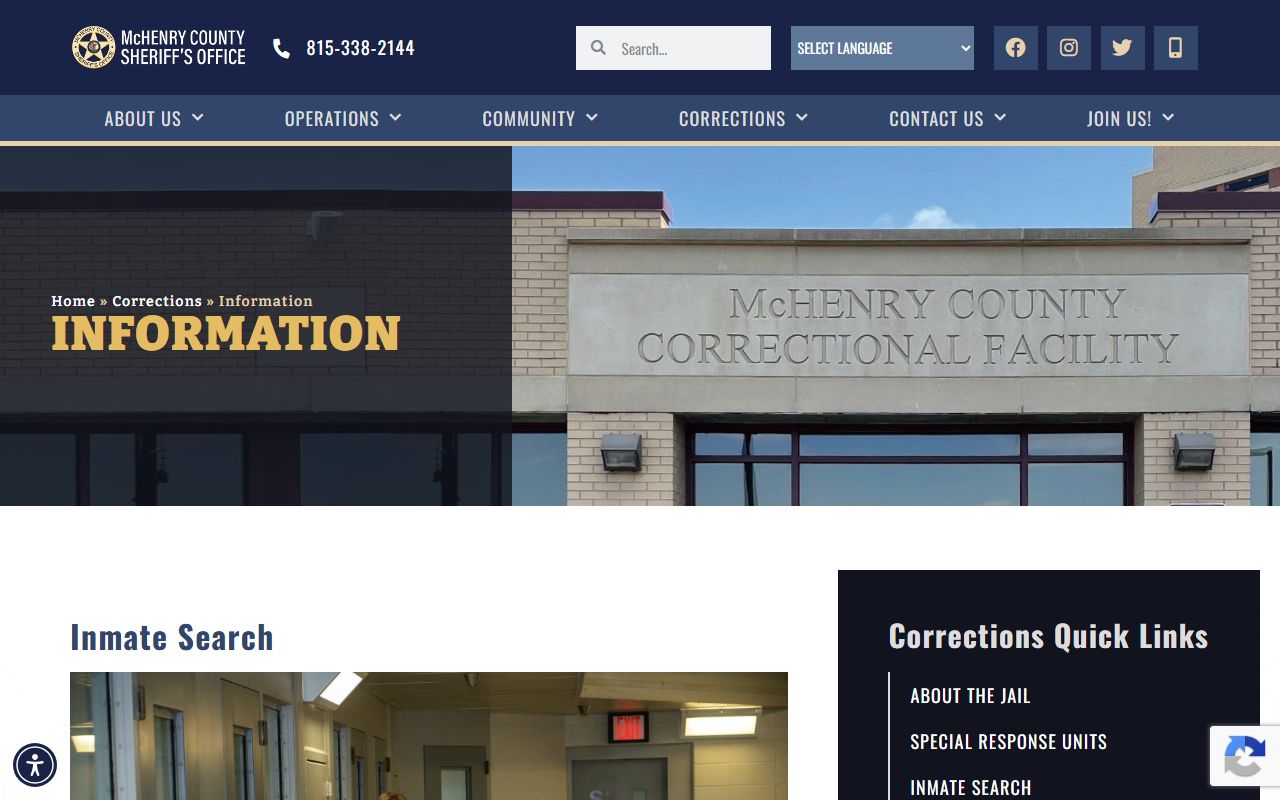
The corrections page is also where visiting rules, mail rules, and money deposit instructions are posted. Use it as the source of truth for any jail policy question, since policies and vendors change.
What a McHenry County Inmate Record Shows
Each inmate profile in the county roster pulls from the Sheriff's booking system. Not every field is shown in every record, since some fields depend on the case stage, the type of hold, and the data the arresting agency sent over. The table below lists the fields commonly published when the profile is open. Use the field list to plan your search and to know what the public roster does and does not say.
| Field | What It Shows |
|---|---|
| Name | Full legal name as recorded at booking. Aliases may also appear. |
| Booking Number | Jail identifier assigned at intake. Used to track property, court paperwork, and prior bookings. |
| Booking Date and Time | When the person was processed into the jail. Different from the arrest moment. |
| Age or Date of Birth | Age and, where public, date of birth. Some fields may be partly redacted for privacy. |
| Sex, Race, Description | Physical description from the booking entry. Used for identity, not characterization. |
| Arresting Agency | Sheriff's Office, a local police department, Illinois State Police, or another agency. |
| Charges or Offenses | Alleged charges at booking. These are claims, not convictions. |
| Bond or Custody Status | Bond amount where set, no-bond hold, pretrial release, hold for another agency, or sentenced. |
| Court Case Number, Next Court Date | Linked court case identifier and the next scheduled appearance, when shown. |
| Release Date | Listed when the portal retains the record after release, or when a sentence end date is set. |
A booking entry is not a conviction. Charges may be amended, dismissed, or replaced with different counts after the State's Attorney reviews the case. The next court date in the roster is for jail tracking. The official court schedule is the Circuit Clerk docket, and if the two differ, the Clerk's docket controls.
Booking and Intake at the McHenry County Jail
After an arrest, the person is moved to the McHenry County jail at the Woodstock government center campus or to another approved law enforcement facility. Booking is the formal intake step. It usually covers identity verification, fingerprints, a booking photo, property inventory, warrant and hold checks, a medical and mental health screen, and the entry of charges or holds into the jail system. Personal items are tagged and held for the detainee. Items that the arresting agency seizes as evidence are not held by the jail; those stay with the investigating agency and follow case rules.
Once booking ends, the person is held pending one of several outcomes: pretrial release under court conditions, posting of a financial condition where set, court appearance, transfer to another agency, completion of a county sentence, or release after dismissal or other court order. Classification staff assign housing based on factors like charge, prior record, medical needs, and safety. Classification details and housing are not published in the public roster, and the jail will not confirm them by phone to the general public.
Identity errors at intake are rare but possible. If you believe a person was booked under the wrong name, or that two people with similar names have been confused, contact an attorney or the jail through official channels. Do not rely on a private background data site, since those services often republish stale or mismatched intake data without the corrections that follow.
Bond and Pretrial Release Under Current Illinois Law
Illinois pretrial release law has changed in recent years. The court, not a fixed bond schedule, sets release conditions in most cases. A judge may release a person on their own recognizance, set conditions such as electronic monitoring or check-in, or order detention where the law permits. Older language about cash bail no longer applies the same way it used to in Illinois. Pretrial decisions in McHenry County criminal cases are made under the current Code of Criminal Procedure as amended by the Pretrial Fairness Act. See 725 ILCS 5 for the Code itself.
The roster may show a bond amount, a no-bond status, a pretrial release flag, or a hold notation. Read the entry as a snapshot, since court orders can change the status the next business day. If a family member wants to plan pickup or court attendance, the Circuit Clerk docket and a call to the jail are better than guessing from a single roster field.
Pretrial release with conditions is not the same as a closed case. Missed conditions, missed court dates, or a new arrest can lead to a warrant, a return to custody, or new charges. For active warrant questions, see the McHenry County warrant records page.
Holds, Transfers, and Why a Released Inmate May Still Be in Custody
A person can clear the McHenry County case on the booking and still stay in jail. Holds change the picture in real time. An out-of-county warrant can keep a person in the McHenry jail until the issuing county arranges transport. A probation or parole hold can keep a person in custody while a violation hearing is set. A federal immigration detainer can affect release timing where federal law allows. A hold from a state agency for a sentenced transfer can also delay release.
Transfers between facilities also affect what the roster shows. A person sentenced to state prison stays in the McHenry County jail until the Illinois Department of Corrections sets the transfer. A person with a federal indictment may be moved to a U.S. Marshals facility. While a transfer is being scheduled, the local roster may still show the person, or it may already mark them as released for county purposes even though they are not free.
If the public roster says a person is no longer in McHenry County custody, that does not always mean they have been released to the public. It can mean a transfer to another agency. To track sentenced state custody, use the Illinois Department of Corrections search described later on this page. To track federal custody, use the Bureau of Prisons inmate locator. For updates after release, see the released inmates page.
Visitation, Mail, and Money Deposits
The Sheriff's corrections page is the authoritative source for current visiting hours, mail addresses, money deposit vendors, phone service providers, and commissary providers. These rules and vendors change more often than court rules, so the page below should be checked before a visit, a deposit, or a mailed letter. The general rules summarized here are common in Illinois county jails, but McHenry's exact rules must be verified at mchenrysheriff.org/corrections/corrections-information.
| Topic | Where to verify |
|---|---|
| In-person visitation | Sheriff's corrections page for current days, hours, session length, and visitor limits. |
| Video visitation | Sheriff's corrections page for the official video vendor, account setup, and pricing. |
| Visitor ID | Sheriff's corrections page; a government photo ID is normally required. |
| Dress code | Sheriff's corrections page for the exact list of prohibited clothing items. |
| Children | Sheriff's corrections page for minor age rules, guardian supervision, and ID requirements for minors. |
| Attorney visits | Sheriff's corrections page; attorney visits use a separate process from social visits. |
| Sheriff's corrections page for the correct mailing address, inmate name and ID format, and prohibited items. | |
| Money deposits | Sheriff's corrections page for the approved kiosk, online vendor, or phone deposit process. |
| Phone calls | Sheriff's corrections page for the phone provider, account setup, and call monitoring notice. |
| Commissary | Sheriff's corrections page for order days, spending limits, and prohibited items. |
Mail screening is standard. Letters with cash, stamps, stickers, perfume, glitter, lipstick, Polaroids, or third-party packaging are commonly refused or destroyed. Some jails scan nonlegal mail and deliver scanned copies on a tablet rather than the original letter. Legal mail from an attorney or court is handled under separate rules and should be marked clearly as legal mail. Do not include cash or contraband in any letter.
Money deposit fees and posting times depend on the vendor under contract. Online deposits usually post the fastest. Kiosk deposits at the lobby may take longer to clear into the inmate account. Refund rules vary by vendor. If the deposit will be used for phone calls, commissary, tablet content, or medical co-pays, ask the vendor whether the account is shared across services or kept separate.
Attorney Access vs Social Visitation
Attorney access is not the same as a social visit. A lawyer who needs to meet a client at the McHenry County jail uses the attorney visit process posted by the Sheriff's corrections division. Attorneys are normally allowed broader hours than social visitors, but they still need to follow identity checks and security rules. Attorney-client phone calls are also subject to jail policy and court rules, and a lawyer should confirm whether a given line is recorded before discussing case strategy.
People in custody who do not have a private attorney may qualify for appointed counsel. The court, not the inmate, controls Public Defender appointment. Eligibility is usually decided after a financial screen. The McHenry County Public Defender represents indigent defendants in qualifying criminal and related cases. For civil legal aid not tied to criminal charges, Illinois Courts self-help and Prairie State Legal Services serve McHenry County residents who meet eligibility guidelines.
McHenry County Jail Contact Information
The jail sits on the McHenry County government center campus alongside the courthouse. Use the Sheriff's official site for the current jail line and visiting hours. Do not rely on third-party directory listings for current phone numbers.
McHenry County Sheriff's Corrections
Government Center campus
Woodstock, IL 60098
Use the Sheriff site to verify jail line and current visiting hours.
Inmate Search by Name
Official county roster
Updated as bookings are processed
Last and first name fields
Inmate Search by Booking Date
Official county roster
Same data as the name search
Date field
Court schedule questions for people in custody should go to the Circuit Clerk. Use the McHenry County public case access portal to confirm the court date listed in the jail profile, or call the Clerk's office if a court date appears to conflict between systems. For the Circuit Clerk profile and counter hours, see the clerk of court page.
State and Federal Custody Searches
The McHenry County roster only covers people currently held in the county jail. If the person you are searching for has been sentenced to state prison, is in federal custody, or was transferred to another agency, a different official tool is needed. Each of these tools is free, official, and run by the agency in charge of that custody system.
The Illinois Department of Corrections Individual in Custody Search covers state prison custody for people sentenced under Illinois law. Search by last name, first name, or IDOC number; the IDOC number is the most precise. The screenshot below is from the official IDOC search page.
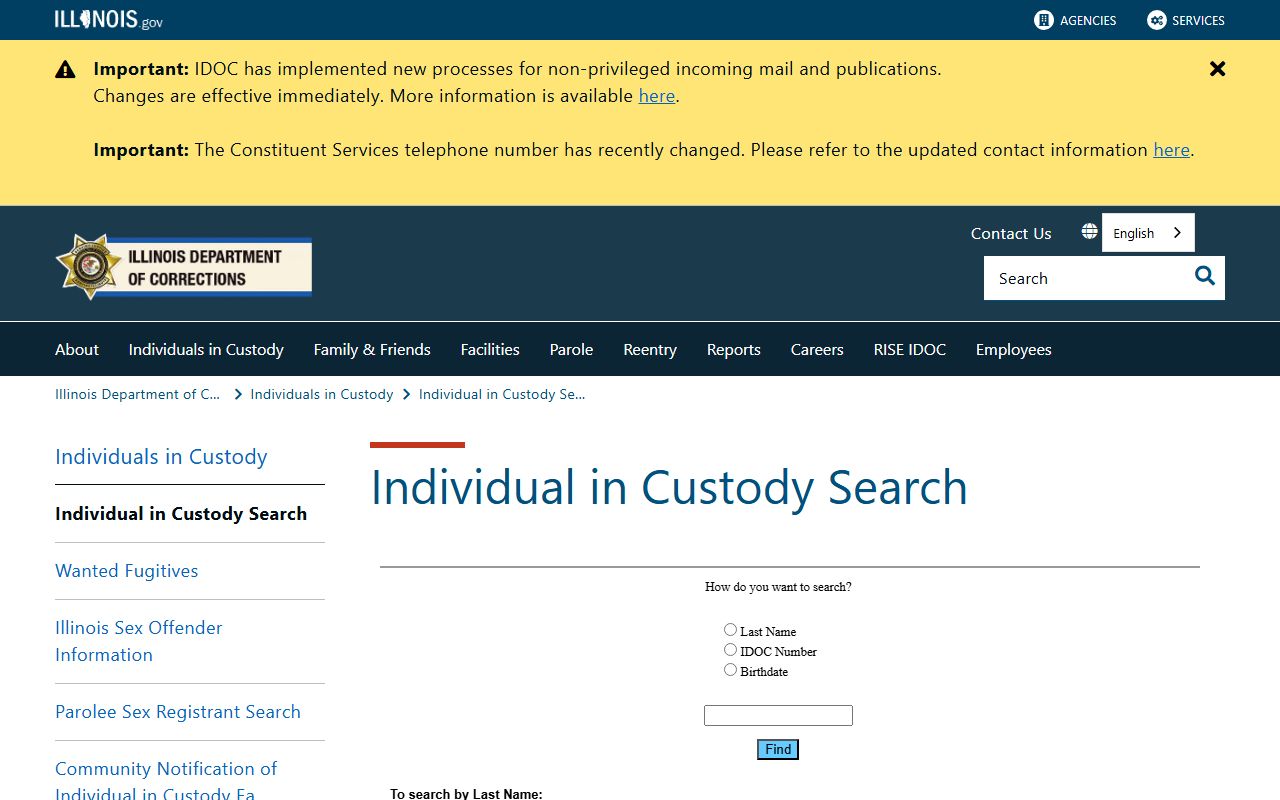
IDOC is the state prison system. A McHenry County defendant convicted of a felony and sentenced to state prison is transferred from the county jail to IDOC after sentencing paperwork is processed. Until that transfer, the person stays in the county jail and shows in the county roster.
The Federal Bureau of Prisons inmate locator covers federal prisoners. Search by BOP register number or by name with race, sex, and age filters. Federal cases are prosecuted by the U.S. Attorney's Office in the Northern District of Illinois, not by the McHenry County State's Attorney. Federal pretrial detainees may be held in contract facilities rather than BOP institutions, so a name that does not appear in the BOP locator does not always mean the person is not in federal custody.
For release notifications, VINELink is a free service that lets a registered user receive alerts about custody status changes for participating agencies. Notification coverage depends on whether the agency feeds data into VINE. The screenshot below is from the VINELink homepage.
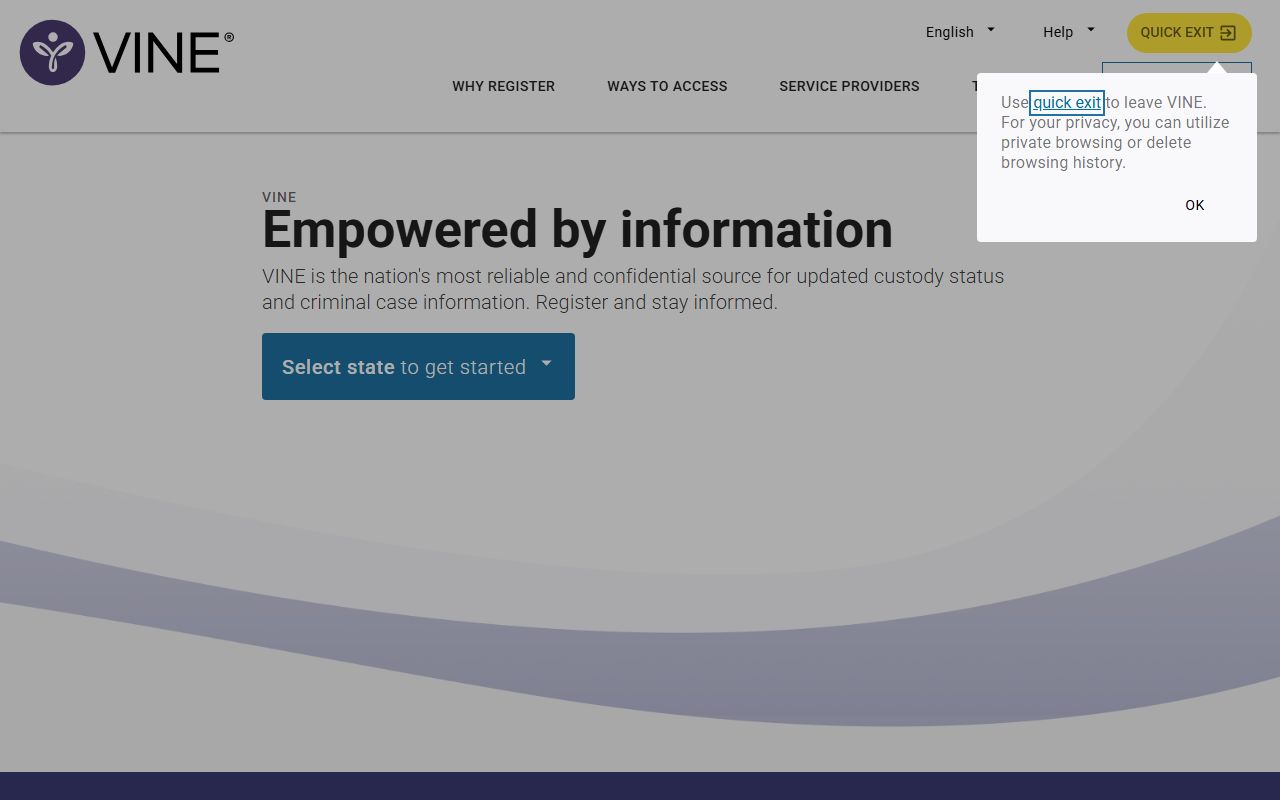
VINELink registration takes a phone number, email, or text contact. Test alerts can confirm the system is reaching you. Do not rely on VINELink alone for safety planning, since data feeds can be delayed; combine it with direct calls to the jail or court when the situation is urgent.
People searching for a registered sex offender in McHenry County can use the Illinois State Police sex offender registry. The registry is separate from the jail roster and the prison custody systems.
What McHenry County Inmate Records Do Not Show
The public roster is built for identification and basic custody tracking. It is not a full case file, and it is not a medical record. Some categories of information are kept out of the public view on purpose, both for inmate privacy and for jail security.
Housing details such as pod, tank, or cell number are usually not public. Classification status, protective custody, segregation status, and suicide watch are not public. Medical conditions, mental health treatment, prescriptions, and dietary restrictions are not public. Disciplinary history inside the jail is not public. Inmate-on-inmate enemy lists and security flags are not public. If a profile is silent on one of these fields, the jail will not fill in the blank for the general public; staff will speak with verified next of kin, attorneys, or court-authorized parties through official channels.
Mugshots are a separate question. Where the county roster shows a booking photo, treat it as a booking image at one moment in time, tied to the active profile. Once the profile is taken down, the image may go with it. Third-party mugshot aggregators are not a reliable source. They often republish old images, mix up similar names, and offer paid removal that does not reach the official record. For accurate identification, use only the official county roster image while the profile is active.
Records of older bookings that are no longer in the public roster may still exist in the Sheriff's internal system, but they are not always part of the public search. For older case outcomes, the court docket through the Circuit Clerk is the better path. The docket carries the filing, charge, disposition, and sentence even after the person leaves the jail, subject to sealing, expungement, and juvenile rules.