
McHenry County Probate Records and Where They Live
Probate matters in McHenry County are heard in the Probate Division of the Circuit Court. The case file is a court file. That means the official copy of every petition, will, letters of office, inventory, accounting, claim, order, and final report sits with the McHenry County Circuit Clerk, not with the County Clerk and not with the Recorder. The Probate Division is a docket within the Circuit Court at the Woodstock courthouse, not a separate building or a separate court.
People often confuse three offices. The Circuit Clerk holds the probate case file. The McHenry County Clerk issues death certificates as a vital record, which is a separate transaction from the court estate. The Recorder holds deeds, mortgages, and recorded liens that may relate to estate real estate. A probate search that wants the will and the orders starts with the Circuit Clerk. A request for a certified death certificate starts with the County Clerk.
The official Illinois statute is the Probate Act of 1975, codified as 755 ILCS 5. It sets the rules for wills, estates, claims, letters, and guardianships across every county. For a deeper profile of the office that holds the file, see the Circuit Clerk page. For vital records the County Clerk produces, see the County Clerk and Recorder page.
What McHenry County Probate Records Cover
Probate is a broad case type. The Probate Division docket in McHenry County handles every kind of estate and guardianship matter that flows through the Circuit Court under the Probate Act. The list below is the working scope of probate work and matches the case categories used by the Circuit Clerk.
- Wills admitted to probate.
- Decedent estates, both testate and intestate.
- Letters of office for executors and administrators.
- Independent and supervised administration under Illinois practice.
- Claims filed against estates by creditors and other claimants.
- Inventories and accountings prepared by the representative.
- Real estate sale orders entered as part of estate administration.
- Guardianship of disabled adults.
- Guardianship of minors.
- Trust-related litigation when the dispute is filed in court.
Some related matters are not probate. A will contest can be filed in probate, but a pure trust dispute may sit in chancery if no estate is open. A small estate handled by affidavit does not generate a court case at all because the affidavit is used outside of court to collect limited assets. The Circuit Clerk publishes case-type codes that show how a probate matter is filed and tracked once it lands on the docket.
How to Search McHenry County Probate Records
The public case access portal at caseinfo.mchenrycountyil.gov/pca is the starting point for any McHenry County probate records search. The portal lists estate and guardianship cases by case number, by decedent or ward name, by case type, and by filing date range. A case number is the most accurate way to open a file because estate captions can be long and share common surnames. A name search works when no case number is on hand, but it may return several hits and may pull cases that share a name with the decedent.
Probate file numbers in Illinois carry a year and a probate code. A search by decedent name should use the full legal name, including a maiden name when relevant. For guardianship of a minor or a disabled adult, the ward is the named party. Court rules limit what is visible online for guardianships, since medical and minor information is sensitive. Estate dockets show events and orders. Document images may need a copy request through the Circuit Clerk copy request page.
| Field | Type | Required | Notes |
|---|---|---|---|
| Case Number | text | optional | Best identifier when known. Faster and more accurate than a name. |
| Decedent or Ward Name | text | optional | Use full legal name; try maiden name variants for older estates. |
| Case Type | filter | optional | Probate or guardianship when the dropdown is offered. |
| Filing Date Range | date | optional | Helps narrow older probate files across many years. |
| Search | button | n/a | Runs the query against the public case access index. |
A blank result is not always proof that no estate was opened. Recently filed cases can lag on the public index. Sealed or restricted guardianship files may not appear in a basic public search. For urgent deadlines, such as a claim filing window, call the Circuit Clerk to confirm before relying on a screen view.
What McHenry County Probate Records Show
A probate case file is more than a one-line outcome. The portal exposes the docket and key party information. The full document images, such as the will and the letters of office, may need a copy request. Expected fields in a McHenry County probate records view are listed below, drawn from the public case access portal layout.
| Field | What It Shows |
|---|---|
| Case Number | Year and probate code assigned by the Clerk at filing. |
| Filing Date | Date the petition for probate or guardianship was filed. |
| Case Type | Decedent estate, adult guardianship, minor guardianship, or related code. |
| Caption | Estate of the decedent or guardianship of the ward. |
| Petitioner | Person who asked the court to open the estate or guardianship. |
| Representative or Guardian | Executor, administrator, or guardian appointed by the court. |
| Attorney | Counsel of record for the estate or guardianship. |
| Judge | Probate Division judge handling the call. |
| Docket Events | Filings, orders, hearings, continuances, letters issued, claims, accountings. |
| Restricted Items | Medical, minor, and sealed material redacted under court rules. |
Inventories and accountings can show assets, debts, receipts, distributions, and representative fees. Some of that is public, but sensitive account numbers and personal identifiers are redacted under the Illinois Supreme Court Rules and the Probate Act privacy provisions.
How Probate Works in McHenry County
The Probate Division follows a set sequence that traces from the petition through final discharge. Each step is an event on the docket. The steps below mirror the working flow used in the Probate Division of the Circuit Court, with the Clerk holding the file the whole way. The image below comes from the official statute page maintained by the Illinois General Assembly.
The Probate Act of 1975 sets every key rule for these steps; the source page at the Illinois General Assembly publishes 755 ILCS 5 in full.
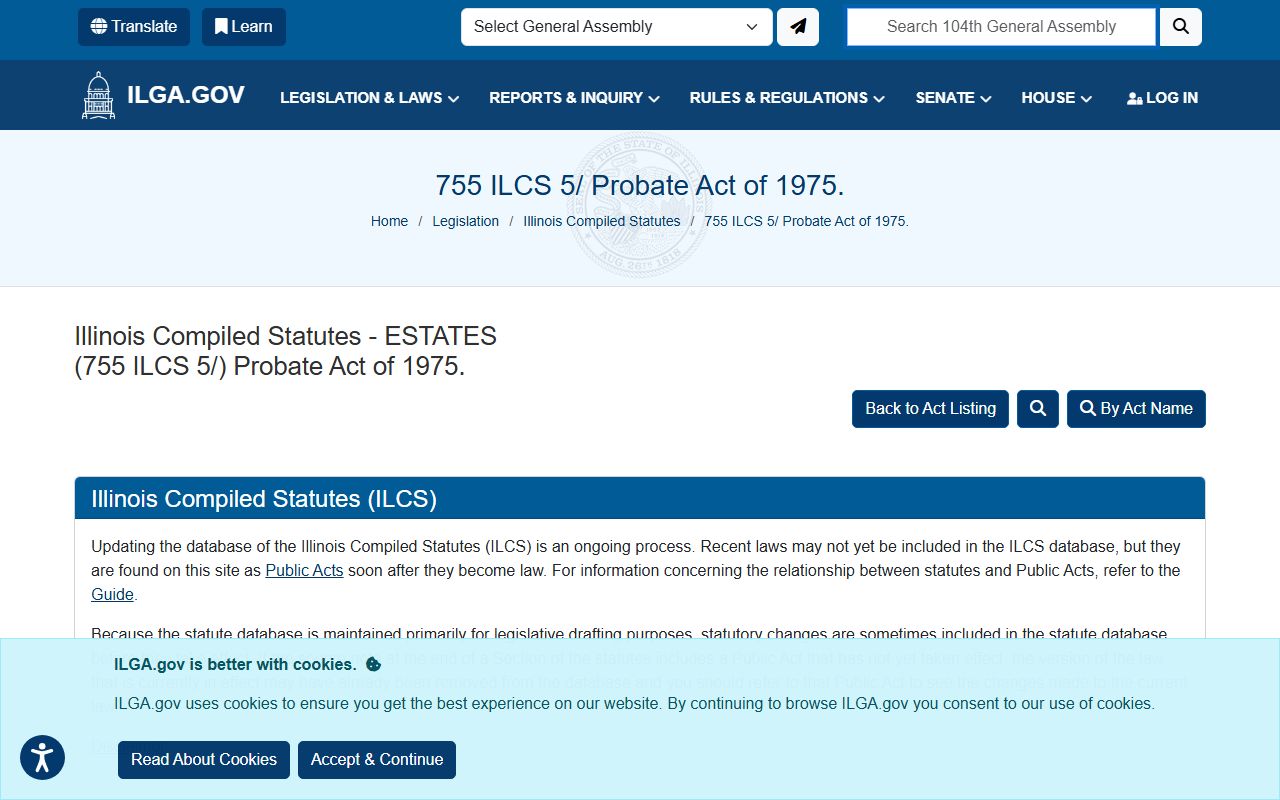
That statute page is the controlling state law for every estate, will, claim, letters of office, and guardianship matter filed at the Woodstock courthouse.
- Decide whether a court estate is needed, or whether a small-estate affidavit will work for limited assets.
- File the petition and the original will, when one exists, with the Circuit Clerk under the Probate Division.
- The court appoints a representative or guardian and issues letters of office.
- Notice is given to heirs, legatees, creditors, and other interested persons under the Act.
- Assets are inventoried and creditor claims are processed during the statutory claims period.
- The court approves disputed issues, real estate sales, accountings, guardianship reports, or distributions.
- The estate or guardianship stays open until the final accounting or report is approved and the representative or guardian is discharged.
Simple estates often take months. A contested will, a real estate sale, a tax dispute, a creditor fight, or a complex guardianship can stretch out much longer. The court does not promise a fixed timeline, and the Circuit Clerk cannot predict one either.
McHenry County Probate Terms Explained
Probate uses words that do not show up in daily life. A short glossary helps a self-represented filer or a curious researcher read the docket. The terms below are pulled from the Probate Act and from common Illinois probate practice.
- Testator
- A person who made a will.
- Executor
- A person named in a will to administer the estate, appointed by the court through letters of office.
- Intestate
- A person who died without a valid will, with assets distributed by Illinois statute.
- Letters of Office
- The court document that proves authority of an executor, administrator, or guardian to act for the estate or ward.
- Guardian ad litem
- An attorney or representative appointed to protect a child or disabled adult during a probate case.
- Independent Administration
- Illinois practice that lets the representative handle most steps without court approval for each act.
- Supervised Administration
- Court oversight of estate steps, often used in contested or complex cases.
- Inventory
- A list of estate assets filed with the court by the representative.
- Accounting
- A report of estate receipts, disbursements, and distributions filed with the court.
A docket entry that names one of these terms is a pointer, not the full story. The underlying document is the source of the rule that applies in the case. Many filers ask the court for help and learn the Clerk cannot give legal advice. Statewide self-help material from the Illinois Courts self-help center covers each of these terms in plain language.
Wills, Letters of Office, and Estate Administration
A will is a written direction for how a person wants assets handled at death. In McHenry County, the original will is filed with the Circuit Clerk when the estate is opened. The court admits the will if it meets the statute. After admission, the court issues letters of office to the executor named in the will. Banks, brokerage firms, title companies, and buyers usually want certified letters of office before they release funds or close on estate property. A docket entry alone is often not enough proof for a third party.
Copies of the will and letters can be requested through the Circuit Clerk. The copy request page sets the procedure for plain copies and certified copies. Statewide approved probate forms are available through the Illinois Supreme Court approved forms library, and the Circuit Clerk publishes county forms on the forms page. Self-represented filers should match each filing to the right form and to the right division to avoid rejections.
If a decedent left a will but the original cannot be found, the case becomes more complex. Copies of a will can create proof problems. The court may need testimony about the original document, search efforts, and the decedent's intent. People in that situation should not file blind; an attorney can save weeks of delay and the cost of a second hearing. Free help may be available through legal aid if the family qualifies.
Guardianship in McHenry County Probate
Guardianship cases are filed in the Probate Division alongside decedent estates. The court can appoint a guardian for a disabled adult who cannot manage personal or financial affairs, and the court can appoint a guardian for a minor when the parents are unable to act or have consented. The Probate Act sets the test for adult disability and the process for minor guardianship, including notice, evaluation, and reporting duties of the guardian.
Adult guardianship files contain medical and disability evidence. Public access to those files is narrower than to ordinary estate cases. Doctor reports, psychological evaluations, and treatment summaries are restricted under the Mental Health and Developmental Disabilities Confidentiality Act and court rules. Minor guardianship files also include protected child information. A docket entry can show that a hearing happened without exposing what was said about the ward's health.
Note: Adult guardianship files in McHenry County probate records can carry sealed medical and disability material; public search results may omit fields that would otherwise appear in a routine estate case.
Probate vs Small-Estate Affidavit
Illinois has a small-estate procedure that lets some families collect limited assets without opening a court estate. The small-estate affidavit is signed under oath outside of court and presented to banks, brokers, or other holders of estate funds. The threshold and the rules sit in the Probate Act, and the dollar limit changes by statute over time. The page does not invent a current threshold; the source statute and the Circuit Clerk fee page are the right place to confirm the current cap and any local procedure.
Small estate is not always the answer. Real estate cannot be transferred by affidavit. Contested heirs, missing wills, large debts, taxes, or non-resident decedents often force a formal probate even when the assets look small. Many families start with the affidavit and then learn the bank or title company wants letters of office. The Probate Division can open the formal case at that point. A short consult with an attorney can save weeks of false starts.
Free help with these decisions is available through Prairie State Legal Services, which serves residents who meet income limits. The image below comes from the official Prairie State site.

Prairie State Legal Services covers McHenry County residents, and probate intake may include estate questions, guardianship of a minor, and other family-court matters.
Fees for McHenry County Probate Records
Probate filing fees, copy fees, and certification fees are published by the Circuit Clerk on the official fees page. Filing assessments in Illinois are set under the Clerks of Courts Act and related statutes, and probate-specific items can vary based on case type. Exact dollar amounts are not invented on this page; the Circuit Clerk fee schedule is the source of truth, and amounts should be confirmed before mailing a request or filing a petition.
| Item | Where to verify |
|---|---|
| Probate petition filing fee | Circuit Clerk fee schedule |
| Guardianship filing fee | Circuit Clerk fee schedule |
| Letters of office issuance fee | Circuit Clerk fee schedule |
| Plain copy per page | Circuit Clerk fee schedule |
| Certified copy per page | Circuit Clerk fee schedule |
| Death certificate copy | County Clerk vital records page |
| Recorded deed or estate property copy | Recorder fee schedule |
Self-represented filers who cannot afford filing costs may apply for a fee waiver using the statewide form. The waiver process is set by the Illinois Supreme Court, and the approved forms library publishes the current application. The Circuit Clerk processes the waiver request and the judge rules on it.
Self-Help for McHenry County Probate
Probate work is one of the harder areas for a self-represented filer. The rules are technical, the deadlines are firm, and small mistakes in a notice or an accounting can stall a case. Free or low-cost help is available for McHenry County residents who qualify. Prairie State Legal Services covers the northern Illinois area and screens for income and case type. Illinois Legal Aid Online publishes step-by-step guides for probate, guardianship of a minor, and related family topics. The Illinois State Bar Association runs lawyer referral resources and public information for the public.
Court staff and Clerk staff can hand out forms, explain procedures, and accept filings. They cannot pick the right form for a case, predict what a judge will do, or give legal advice. A family facing a contested will, a guardianship dispute, a tax issue, or a real estate sale should plan on hiring counsel or seeking aid. The Twenty-Second Judicial Circuit at 22ndcircuitil.gov publishes division pages, judge assignments, and standing orders that can save time before a hearing.
Federal Context for Probate-Adjacent Matters
Estates do not always stay in state court. A decedent or an estate party may have a federal case open at the same time. The most common overlap is bankruptcy, which is a federal court matter heard in the U.S. Bankruptcy Court for the Northern District of Illinois. A creditor of an estate can have a federal claim. A trustee of a bankrupt party may interact with a McHenry County estate. Federal docket access runs through PACER, the federal court records system, with its own user account and fee rules.
The PACER homepage explains how to register, how the fee structure works, and how to access federal dockets. The image below comes from the official PACER service.
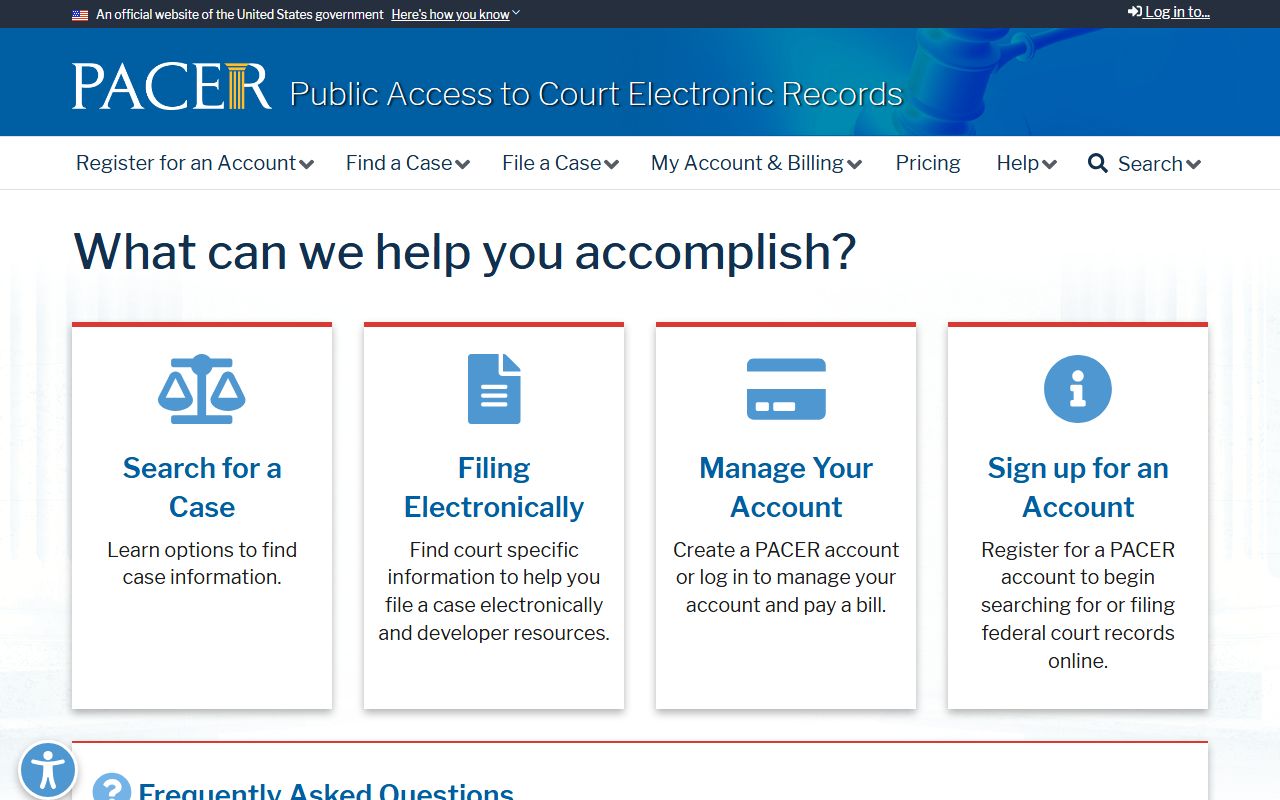
PACER is separate from the McHenry County Circuit Clerk; a probate file in McHenry County does not appear on PACER, and a federal bankruptcy file does not appear on the county public case access portal.