
How to Search McHenry County Criminal Records
Criminal records search in McHenry County splits between two systems: the Circuit Clerk's public case access portal for court files, and the Sheriff's inmate lookup for current jail custody. The court portal is the right tool for charge, plea, sentence, supervision, probation, and disposition data. The jail tool is the right place to see who is in custody right now and what charges were booked. A police report or arrest narrative is a third record type held by the arresting agency under FOIA, not by the court. Pick the right system before you start, and a name search will return useful results much faster.
Gather what you know before you open the portal. A full legal name with spelling variants, a date of birth where allowed, the year of arrest or filing, and a case or citation number all help narrow a search. A case number is the most precise key. The official starting point is the McHenry County Public Case Access portal, run by the Circuit Clerk. For booking and custody, the county runs official inmate lookups by name and by date. For police reports, send a FOIA request to the arresting agency, which is often the McHenry County Sheriff's Office or a municipal department.
- Open the Circuit Clerk public case access portal in a normal browser. If a security check appears, allow cookies and scripts and try again.
- Use the case number when you have one. Illinois case numbers encode the year, the case type code, and a sequence, which makes them a fast and exact key.
- If the case number is not known, run a party name search. Enter the full legal name, then try maiden, hyphenated, and shortened forms.
- Filter by case type or date range if the portal exposes those options. This helps a lot with high-volume misdemeanor and traffic-criminal calendars.
- Open the case detail page to read the charges, plea, court dates, judge, courtroom, dispositions, and any warrant or bond events.
- For police reports or arrest narratives, send a FOIA request to the arresting agency. The Circuit Clerk does not hold police-created records.
- For copies of court documents not shown online, file a copy request with the Circuit Clerk. Certified copies cost more than plain copies and are needed for legal proof.
A blank result is not always proof that no case exists. Sealed, expunged, juvenile, or impounded matters can be missing from the public portal even when the underlying event happened. If a deadline is close, call the Clerk's office before you act on what the portal shows.
Arrest Records vs Court Criminal Records in McHenry County
An arrest record and a court criminal record are not the same thing. An arrest record is created by the police or Sheriff's deputies at the time of arrest, and it covers booking, charges alleged at arrest, the arresting agency, and the booking facility. A court criminal record begins when a charge is filed with the court and tracks the case from charging through disposition. The two records can differ. A person can be arrested and never charged. A charge filed at arrest can be amended, reduced, or dismissed by the State's Attorney. The final outcome lives in the court file, not the arrest report.
The Circuit Clerk holds the court file. The Sheriff holds the jail roster and booking data. Local police departments hold the incident report and arrest narrative for arrests made by their officers. State Police hold records of arrests made by state troopers, plus the statewide criminal-history file that is built from agency submissions under the Criminal Identification Act.
Below is the official Illinois Criminal Identification Act, which is the statute that governs how arrest data is reported, kept, and shared by Illinois agencies. The image links back to the official Illinois General Assembly page for 20 ILCS 2630.
The Act is the legal backbone for arrest reporting, expungement, sealing, and criminal-history dissemination in McHenry County and across Illinois. It is the statute users land on when they ask whether an old arrest can come off a public record.
What McHenry County Criminal Records Show
A criminal case file in the McHenry County Circuit Court is more than a one-line outcome. The docket tracks each event in the case in order, and the documents are linked to the docket entries. The public portal exposes most of the index data; document images may need a copy request through the Circuit Clerk.
| Field | What It Shows |
|---|---|
| Case Number | Year, case-type code, and sequence assigned by the Clerk at charging. |
| Charges | Charged offenses with statute citations; can include amendments, added counts, or reduced counts. |
| Parties | Caption shown as People v. defendant; victim and minor identifiers are protected. |
| Filing Date | Date the State filed the charge with the court. |
| Bond / Pretrial | Pretrial release conditions, hold status, electronic monitoring where ordered. |
| Plea | Guilty, not guilty, nolo where allowed, or stand mute; entered at arraignment or later. |
| Disposition | Finding of guilt, not guilty, dismissal, nolle prosequi, supervision, or other outcome. |
| Sentence | Jail or prison time, probation, fines, restitution, conditions, or supervision terms. |
| Docket Entries | Filings, motions, orders, continuances, warrant events, payment activity, and judge findings. |
| Status | Pending, active, disposed, dismissed, sealed, expunged, or transferred where shown. |
Docket text uses court shorthand. Entries like "nolle prosequi," "rule to show cause," "cause set," and "motion entered and continued" each carry a precise meaning. If a docket entry will affect a job, a license, or a sentence, treat the entry as a starting point and confirm what it means with an attorney or with the Illinois courts self-help center.
Charges vs Convictions in McHenry County Criminal Records
Background-check confusion almost always traces back to one thing: confusing a charge with a conviction. A charge is an accusation. A conviction is a final finding of guilt that the court has entered and not vacated. The two appear in the same case file but mean very different things.
| Detail | Charge | Conviction |
|---|---|---|
| What it is | A formal accusation filed by the State's Attorney. | A final finding of guilt entered by the court. |
| Where shown | Charging instrument, docket entries, bond paperwork. | Plea, verdict, or finding plus a sentencing order in the docket. |
| Evidentiary effect | None on its own. The State must still prove its case. | Sentencing, license effects, immigration effects, and future record effects. |
| Public access | Public in the court file unless sealed, expunged, or juvenile. | Public in the court file unless sealed or expunged later. |
Illinois supervision is a separate disposition that can avoid a conviction if the defendant completes the conditions. A "supervision" entry in the docket is not the same as a finding of guilt followed by a conviction. A "nolle prosequi" entry means the State dropped the charge. A "not guilty" finding after trial closes the case in the defendant's favor.
McHenry County Felony and Misdemeanor Cases
The Circuit Court handles both felony and misdemeanor prosecutions for McHenry County. Felonies are the more serious class of offense, with possible state prison terms, and many move through preliminary hearing, grand jury, arraignment, motion practice, and trial or plea. Misdemeanors carry possible county jail time and lower fines, and many resolve at an earlier stage. The Twenty-Second Judicial Circuit's criminal division publishes courtroom and judge information for both classes.
Procedure for both classes follows the Code of Criminal Procedure of 1963. Illinois changed pretrial release law in recent years, so judges set release conditions under current law rather than fixed cash bond schedules. Conditions can include reporting, electronic monitoring, no-contact orders, residence orders, treatment, and surrender of firearms. A defendant who violates a condition can be returned to custody. The court file shows the orders. The jail roster shows current custody status. The Sheriff's corrections page is the right place to confirm whether a person is being held right now.
Below is the official Illinois Code of Criminal Procedure of 1963 page. It is the statute that drives most of what happens between arrest and sentence in a McHenry County criminal case. The link goes to the official Illinois General Assembly page for 725 ILCS 5.
The Code lays out warrants, arrest, pretrial release, charging, motions, trial procedure, and post-trial relief. Many docket entries in a McHenry County criminal case point back to a specific article of this statute.
Sealed vs Expunged McHenry County Criminal Records
Sealing and expungement are different forms of relief. Both can clean up an eligible criminal record, but they do different things to the file and they reach different audiences.
| Detail | Sealed | Expunged |
|---|---|---|
| What happens to the record | Record is hidden from the general public but kept by the court and police. | Eligible record is destroyed or returned, and removed from ordinary public access. |
| Who can still see it | Law enforcement, the courts, and certain employers or licensing bodies authorized by statute. | Very limited access; most public requesters get nothing back. |
| Eligibility basics | Many convictions and supervision outcomes can be sealed after a waiting period and a clean record. | Limited to certain dispositions: dismissals, acquittals, supervision completed, some pardons, and other narrow categories. |
| Where to file | Petition filed in the Circuit Court where the case sits, with notice to required agencies. | Petition filed in the Circuit Court where the arrest or charge occurred. |
Both remedies are governed by 20 ILCS 2630 and related criminal procedure statutes. A McHenry County petitioner files in the McHenry County Circuit Court, identifies arresting agencies, case numbers, charges, dispositions, and the requested relief, and serves the State's Attorney, the arresting police agency, the Illinois State Police, and other required parties.
How Sealing and Expungement Work in McHenry County
A typical McHenry County sealing or expungement petition follows a set path. The petitioner identifies every arrest and case that may be eligible, gathers the case numbers, charges, dispositions, and dates from the Circuit Clerk and the Illinois State Police, then chooses the right relief for each entry. Statewide approved forms from the Illinois Supreme Court forms library are the safe starting point. The petition is filed in the Circuit Court where the arrest or charge occurred. Notice goes to the State's Attorney, the arresting law-enforcement agency, the Illinois State Police, and any other required agency named in the statute.
Agencies can object. The State's Attorney may object based on ineligible charges, an open case, pending charges, or other reasons set in the statute. The arresting agency or State Police may object on records grounds. If no party objects within the statutory window, some petitions may be granted without a contested hearing. If there is an objection, the judge decides whether the petitioner meets the statutory criteria. The court enters an order granting or denying relief in whole or in part. After the order is entered, the Clerk sends it to each agency, and each agency processes the change on its own timeline. Records do not vanish from every system the moment the order is signed.
Common reasons for denial include an ineligible conviction, an incomplete waiting period, a pending case, a missing disposition, the wrong county, or a petition that does not list every required agency. Free help is available through Prairie State Legal Services and the Illinois courts self-help center. The statewide self-help page walks self-represented filers through the forms and steps.
Juvenile Criminal Records in McHenry County
Juvenile records are not handled like adult criminal records. Juvenile delinquency, abuse, neglect, and dependency files are restricted under the Juvenile Court Act of 1987, 705 ILCS 405. Public case access portals in Illinois typically suppress or limit juvenile case data. The existence of a juvenile court date or case may itself be restricted. The general public should not expect to find juvenile case detail in the McHenry County Public Case Access portal.
Authorized users can include the minor, the minor's parents or guardians, the minor's attorney, the State's Attorney, probation, certain agencies, and people the court has authorized in writing. Some juvenile records can be expunged on a separate track under 20 ILCS 2630 and the Juvenile Court Act, with different eligibility rules and waiting periods than adult records. Juvenile petitioners and their parents or guardians should ask the Circuit Clerk's office or the McHenry County Public Defender about the right form for a juvenile petition.
Public Access Laws and Statutes
Illinois uses two access frameworks for criminal information. Court files held by the Circuit Clerk are accessed through clerk procedures, court rules, and the public portal. Records held by the Sheriff, State Police, and the State's Attorney administrative side are public-body records under the Freedom of Information Act, with exemptions for law-enforcement interference, personal privacy, juvenile information, victim data, and records prohibited from disclosure by other law.
Key Illinois Statutes for McHenry County Criminal Records:
20 ILCS 2630 : Criminal Identification Act. Governs state criminal-history records, arrest reporting, expungement and sealing, and dissemination limits.
725 ILCS 5 : Code of Criminal Procedure of 1963. Covers warrants, arrest, pretrial release, charging, trial procedure, and post-trial relief.
705 ILCS 405 : Juvenile Court Act of 1987. Restricts juvenile delinquency, abuse, neglect, and dependency files.
5 ILCS 140 : Freedom of Information Act. Public-body records are open unless an exemption applies; police FOIA requests go to the agency FOIA officer.
730 ILCS 152 : Sex Offender Registration Act. Governs registration and the public registry maintained by the Illinois State Police.
The Illinois State Police runs the statewide sex offender registry, which is a separate public-safety file and not a substitute for a full criminal-history search. The Illinois Attorney General's Public Access Counselor reviews FOIA denials by public bodies. When in doubt about access rights, identify whether the record is a court file or an agency file before choosing a request route.
The McHenry County State's Attorney and Public Defender
Illinois counties have a State's Attorney rather than a District Attorney. The McHenry County State's Attorney prosecutes felony, misdemeanor, traffic-criminal, juvenile delinquency, and certain civil matters on behalf of the People of the State of Illinois. The office decides which charges to file, which to amend, and which to dismiss. A McHenry County criminal record reflects those charging decisions even when the arrest report listed something different.
The McHenry County Public Defender represents eligible indigent defendants when appointed by the court. Eligibility is screened through the court after a financial review. A defendant does not just hire the Public Defender; the court appoints. Private appointed counsel may be used in conflict cases. The State's Attorney and Public Defender are both county offices, but they are not part of the Circuit Clerk and they do not run the public case access portal.
Victim services are coordinated through the State's Attorney's office. Victim impact statements, restitution requests, and protective-order coordination are handled there along with the Illinois Attorney General's crime-victim resources. Domestic-violence survivors may also use local advocacy groups and the Illinois Legal Aid Online portal for plain-language guidance.
Federal Criminal Cases Connected to McHenry County
McHenry County sits in the U.S. District Court for the Northern District of Illinois. Federal criminal cases with McHenry County ties may be filed in the Northern District, depending on venue and jurisdiction. Federal criminal records are not maintained by the McHenry County Circuit Clerk. Federal indictments, plea agreements, sentencing orders, and judgments are court files of the federal district court.
The image below comes from the official U.S. Attorney's Office for the Northern District of Illinois, which prosecutes federal criminal cases that touch McHenry County rather than the county State's Attorney.
The federal prosecutor's office posts press releases, charging announcements, and resource pages that can help a researcher confirm whether a McHenry County name has a federal case. The federal court itself can be searched through ilnd.uscourts.gov and through PACER.
Attorneys and registered users reach federal dockets through the court's CM/ECF electronic filing system.
CM/ECF feeds the same dockets that PACER bills the public to view, so a McHenry County federal criminal file can be confirmed there even though it never appears in the county Circuit Clerk index.
Free secondary access is also available. CourtListener is a permitted free secondary source for federal opinions, dockets, and selected filings. It is not a third-party data aggregator; it is run by the Free Law Project and pulls from official federal court systems. The screenshot below links to CourtListener.
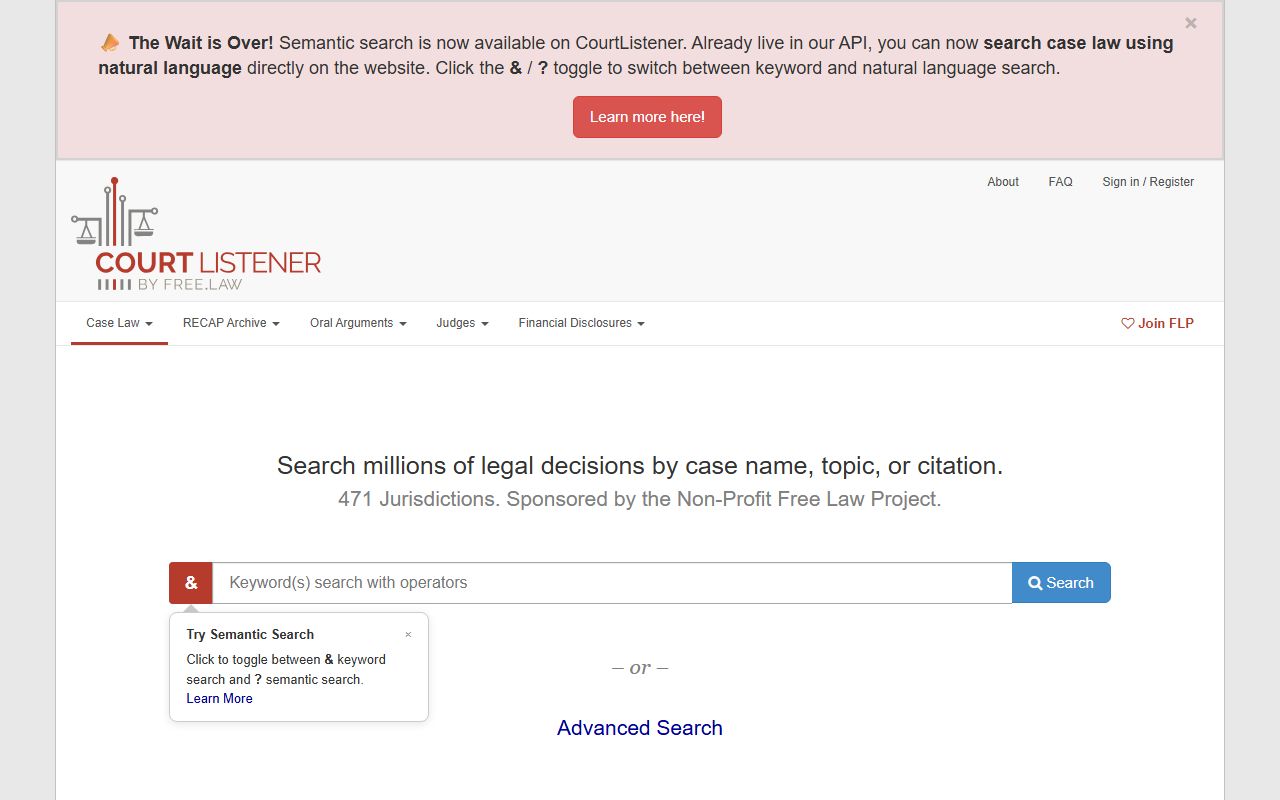
CourtListener is useful when a researcher needs federal opinion text, a public docket entry, or a free copy of a federal filing. PACER remains the official source for full federal dockets and most federal documents.
Background Checks vs Court Records
A commercial background check and a McHenry County court record search are not the same product. A commercial background check pulls from many sources, including aggregator databases, and the data can be stale, mismatched, or merged across people with similar names. A McHenry County Circuit Clerk search is single-source and authoritative for cases filed in this county. For an Illinois statewide criminal-history product, the Illinois State Police runs an official process under the Criminal Identification Act, which is different from a free court docket search.
Anyone who needs a record for a license, an immigration filing, a school program, or a job that requires a certified disposition should order a certified copy from the Circuit Clerk. Plain copies are fine for personal review. Certified copies are the form most agencies accept as proof. The Sheriff's Office and local police can supply incident reports and arrest narratives through a FOIA request, but those are not the same as a court disposition.
- Arraignment
- The criminal hearing where charges are read and the defendant enters a plea.
- Plea
- The defendant's formal response to a criminal charge; guilty, not guilty, or stand mute.
- Conviction
- A final finding or plea of guilt entered by the court and not vacated.
- Sentence
- The punishment or conditions a judge imposes after a conviction or qualifying plea.
- Supervision
- An Illinois disposition that can avoid a conviction if the defendant completes the conditions.
- Bench warrant
- A warrant issued by a judge, often for failure to appear or a violation of a court order.
For warrant lookups and what to do about an outstanding warrant, see the McHenry County warrant records page. For traffic-criminal overlap such as DUI, see the McHenry County traffic court records page.